 Joe Dana

Nearly every county in Arizona has reported a drop in MMR vaccinations since 2019.
PHOENIX — Childhood immunization rates for measles and mumps have decreased significantly across Arizona in recent years, plunging the state further below the threshold that public health officials say is needed to achieve “herd immunity.”

Data compiled by NBC News in partnership with Stanford University shows that 77% of the country’s counties and jurisdictions have reported a decline in MMR vaccination rates since 2019 and most Arizona counties are no exception.
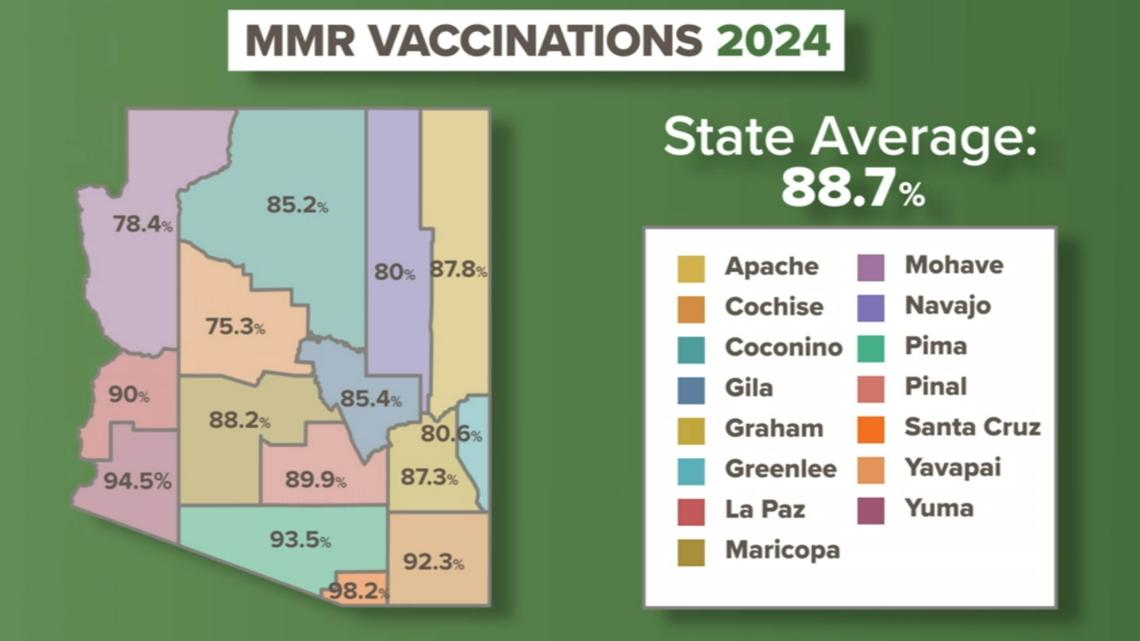
Arizona’s statewide MMR immunization rate dropped from 93.5% to 88.7% between 2019 and 2024. The “ideal” threshold to attain herd immunity and avoid disease outbreaks is 95%, according to messaging from the Arizona Department of Health Services.
The state health department did not respond to inquiries asking how Arizona is responding to the recent increase in MMR vaccine exemptions. But the government website emphasizes how vaccination is a “safe” and “easy way to help keep your family healthy.”
“Different vaccines work in different ways, but every vaccine helps the body’s immune system learn how to fight disease,” the health website states.
2 Arizona Moms Make Opposite Vaccine Choices
Despite efforts by county and state leaders, the mainstream healthcare community’s message is convincing fewer parents overall.
Two mothers on opposite sides of the debate spoke with 12News about their vaccine decisions. They both said their past experience with an older child played a role in how they approached the decision to get vaccinations for their youngest child. Although experts warn against making scientific conclusions based off anecdotal experience, that may be easier said than done.
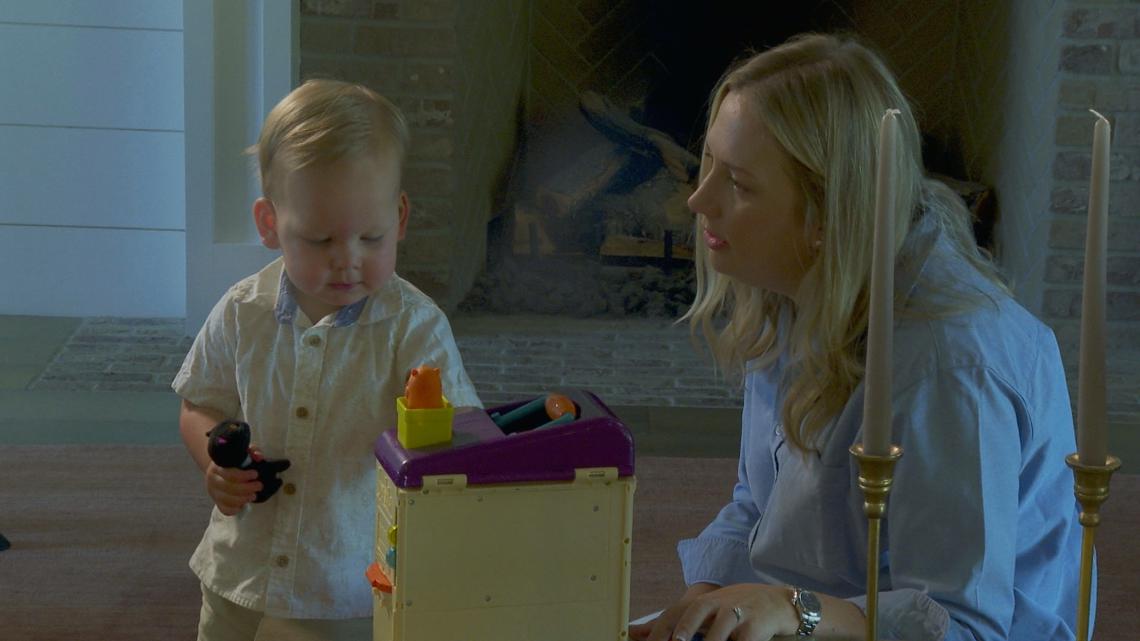
“It wasn’t really a question for my husband and me,” said Karli, a Phoenix mother of two children. “We were vaccinated as children and our oldest was vaccinated.”
Karli said she and her husband have received all scheduled vaccines for their 21-month-old son, Archer, and she considers any controversy over vaccine safety as just “noise.”
“I would say there are more conversations happening, but I don’t think the actual data has changed that much as far as what is going to protect children and protect others,” she said.
Concerns About Multiple Vaccinations
Another mother, “Jane,” who asked not to be identified, told 12News she did not get vaccinations for her 4-year-old daughter and plans to educate her in a micro-school when she enters kindergarten.
Jane said she believes there is a link between the growing number of recommended vaccines in the U.S. with the growing rate of childhood chronic diseases.
“I believe there is a connection there and the more we study this without bias, the more that is going to come out,” Jane said.
According to the CDC’s instruction about vaccine safety, “multiple vaccines at the same time has been shown to be safe.”
“Sometimes, certain combinations of vaccines given together can cause fever, and occasionally febrile seizures; these are temporary and do not cause any lasting damage,” the CDC says on its website.
Jane said she “blindly” got all vaccines for her now 9-year old son, who suffers from severe chronic eczema, allergies, and asthma.
She read the book “Vaccine Family Plan” by Dr. Paul Thomas. According to the Center for Health Journalism, Thomas is a well-known anti-vaccine pediatrician whose license to practice medicine was temporarily suspended in Oregon in 2020 because he did not provide recommended immunizations for children.
“Moms need to know they are smart enough to gather this information, to synthesize conflicting data, to look for conflicts of interest,” Jane said.
Karli said she also considered potential side effects of getting multiple vaccines at once.
“When you have a new baby or a 1-year-old, even when they receive that big chunk of vaccines, you do worry. You worry if they will be in discomfort,” Karli said. “We definitely weighed all the pros and cons and it was the right choice for us.”
Vaccine Rates Dropping Across Arizona
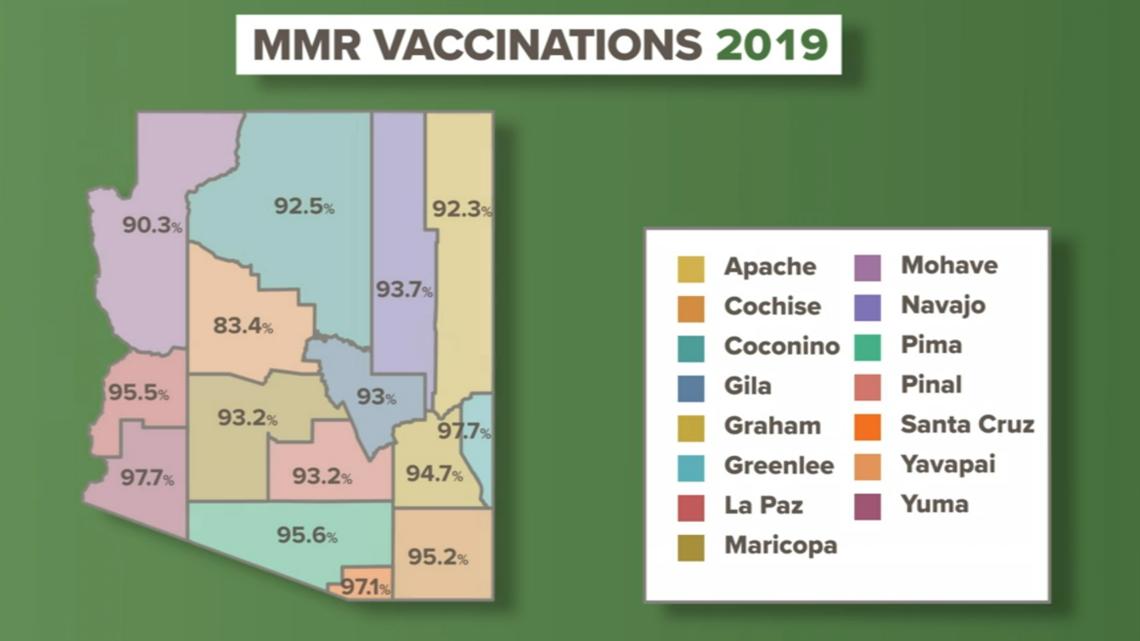
With the exception of Santa Cruz County, all of Arizona’s counties have seen a drop in MMR immunization since 2019. But the decrease in vaccinations has been more prominent is some regions of the Grand Canyon State.
Mohave and Yavapai counties lead the state with the lowest MMR vaccination rates. Between 2019 and 2024, Mohave’s rate dropped from 90.3% to 78.4% and Yavapai’s rate decreased from 83.4% to 75.3%.
Last month, Mohave County officials issued a notice advising residents in the Colorado City area of the active presence of measles in the community, informing them that the MMR vaccine is ” the best protection” against the disease.
Mohave County’s public health department has also developed a “health literacy” newsletter to help residents understand vaccinations and disease surveillance.
“Our goal is always to equip residents with accurate information so they can make informed choices for themselves and their families,” Dani Lagana, a spokesperson for the county health department, wrote in a statement. “We hope parents and guardians understand the potential severity of vaccine-preventable diseases, and we remain committed to providing education, access, and support to our neighbors.”
Arizona’s most populated area, Maricopa County, has reported a drop in MMR vaccinations from 93.2% to 88.2%.
Courtney Kreuzwiesner, a spokesperson for Maricopa County’s public health department, said the agency recommends everyone stays up-to-date on recommended vaccines.
“Vaccines are our best tool for preventing severe disease and hospitalization,” Kreuzwiesner said. “They also help protect the most vulnerable in our community like older adults, children, and people with certain health conditions.”


Vaccines in National Spotlight
The downward vaccination trend comes as a “Make America Healthy Again” report recently released by the Trump administration calls for ramping up investigations into vaccine injuries and developing a framework to ensure the country has “the best childhood vaccine schedule.”
Concerns about vaccine risks are being amplified by Health and Human Services Secretary Robert F. Kennedy Jr., who alleged in June the CDC’s recommended childhood vaccinations are “not tested against an inert placebo.”
Organizations like John Hopkins and the American Academy of Pediatrics explain how clinical trials and comparison groups have proven “vaccines are very safe.” According to John’s Hopkins, inert placebos are not always necessary for trials and can actually be unethical.
Kennedy’s boss, President Donald Trump, even stepped into the conversation last week saying people should be careful to say “some should not be vaccinated.”
“Look, you have vaccines that work. They just pure and simple work. They’re not controversial at all, and I think those vaccines should be used, otherwise some people are going to catch it, and they endanger other people,” President Trump said.
Will Humble, a former director of Arizona’s health department, now runs the nonprofit Arizona Public Health Association and has described the process of vaccine approvals by the FDA and CDC as meticulous and time-tested.
“Vaccines are among the most rigorously tested and monitored medical products we have,” Humble wrote in a June 16 blog post. “The science is clear. The testing is real. And the public deserves better than a steady stream of misinformation and blatant lies from Kennedy.”
Source link
Joe Dana Childhood immunization rates dropping across Arizona, data shows www.12news.com
KPNX Arizona Local News Feed: investigations 2025-09-15 22:55:47
i-team,news,investigations,health,arizona,local +



GIPHY App Key not set. Please check settings