

PHOENIX – On March 19, Arizona is set to carry out its first execution since late 2022.

This time, the person who is set to be executed was found guilty of a murder that happened decades ago.
Here’s what to know about Aaron Gunches, as well as the death penalty in Arizona.
Who’s Aaron Gunches?
Aaron Gunches was sentenced to death for the murder of Ted Price in 2002.
What happened?
What we know:
Price, according to the Associated Press, was the ex-husband of Gunches’s girlfriend at the time. ADCRR’s website states that Price was found shot to death on the Salt River Pima-Maricopa Indian Community, near Mesa.
Per a June 2010 court document that is related to the case, the incident happened in 2002. Price had planned to stay at his ex-wife’s apartment while waiting for a school grant, but the two began fighting, and Price was told to leave after about 10 days.
Price, according to court documents, was initially taken to a bus station, but was later taken to a remote part of the desert, and shot. Price’s body was discovered several days after the incident.
As for Gunches, officials with ADCRR said he was pulled over by a DPS officer near the California state line in January 2003. The DPS officer was shot twice by Gunches, but suffered minor injuries. Ultimately, Gunches was arrested following a manhunt that included over 50 officers.
“Bullet casings found near Price’s body matched the gun Gunches used to shoot Officer Flannery,” read a portion of the ADCRR’s website.
Gunches pleaded guilty to kidnapping and first-degree murder.
Didn’t they try to execute Gunches before?
Gunches has been at the center of a long legal saga following Ted Price’s murder.
Timeline:
Per a 2022 Associated Press article, Gunches was originally sentenced to death in 2008. However, the state’s Supreme Court found an error in the sentencing proceeding, and ordered a new sentencing.
Gunches, according to the article, was once again sentenced to death in 2013.
In November 2022, Gunches filed a request for his own death warrant with the state’s Supreme Court, but he later withdrew that request, stating that he did not know that Kris Mayes, who won election for Arizona Attorney General in the 2022 election, had stated her intentions of “pausing” executions in Arizona.
After she took office as Attorney General, Mayes tried to withdraw a request for Gunches’ death warrant that was filed by her predecessor, Mark Brnovich. The court, however, refused the request. While a death warrant was ultimately granted, Governor Katie Hobbs said her administration would not carry out an execution, and a review of the state’s death penalty protocol was conducted.
The review ended in November when Democratic Gov. Katie Hobbs dismissed the retired federal magistrate judge she had appointed to examine execution procedures.
On Feb. 11, 2025, another execution warrant was issued for Gunches. On Mar. 10, it was reported that Gunches passed on a chance to ask for a reprieve by not taking part in a hearing before the Arizona Board of Executive Clemency.
What’s the method of execution in Arizona?
Under Arizona law, lethal injection is the only method of execution for those who are sentenced to death for a crime that was committed before Nov. 23, 1992.
What The Law States:
“The penalty of death shall be inflicted by an intravenous injection of a substance or substances in a lethal quantity sufficient to cause death, under the supervision of the state department of corrections,” per the relevant portion of the Arizona Revised Statutes.
For those sentenced to death for crimes committed before Nov. 23, 1992, state law allows them to choose between lethal injection or lethal gas at least 20 days before they’re set to be executed. Lethal injection remains the default for those who fail to choose between the two.
Dig deeper:
Per ADCRR records, the most recent execution that was carried out using lethal gas was that of Walter Burnhart LaGrand in March 1999.
The AP reported that Walter and his brother, Karl, both chose lethal gas in hopes that courts would find the method unconstitutional. While Karl ultimately accepted the state’s last-minute offer of lethal injection, Walter rejected it, saying he would prefer a more painful execution to protest the death penalty.
The AP reported that the case drew widespread criticism in Germany, which has no death penalty, and prompted repeated diplomatic protests.
There remains a certain level of controversy surrounding execution by lethal gas in Arizona, with the AP noting that the state’s refurbishment of the gas chamber in 2021 sparked international condemnation, including news coverage in Israel and Germany that drew parallels to Holocaust atrocities.
How many people are there on Arizona’s death row?
By the numbers:
Per ADCRR’s page on death row, there are 112 inmates on death row in Arizona, and that number includes Gunches.
Of the 112 death row inmates, 63 of them (56.25%) are classified by the agency as white, while another 23 (20.53%) inmates are classified as Mexican Americans, followed by 17 (15.18%) inmates who are classified as Black.
The vast majority of those on Arizona’s death row are men, with only three women death row inmates.
When was the last time a person was executed in Arizona?
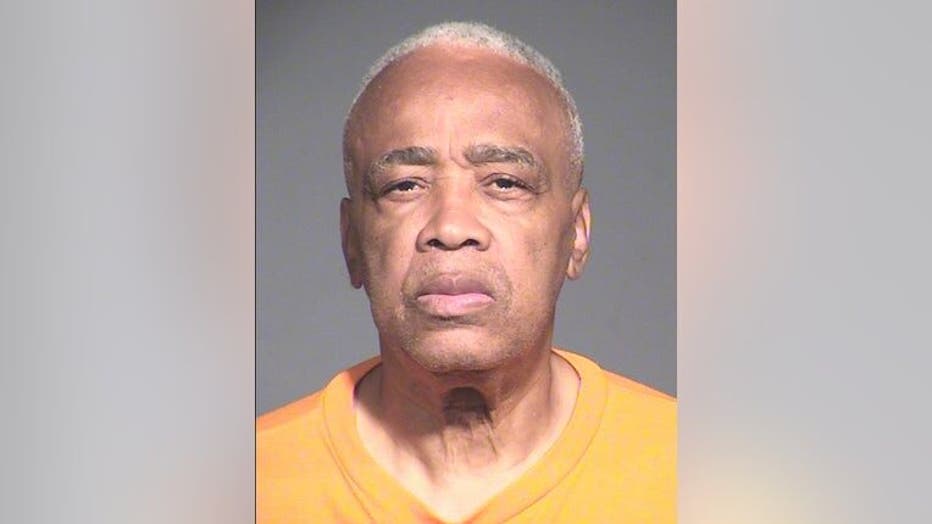
Murray Hooper (Courtesy: Arizona Department of Correction, Rehabilitation and Reentry)
The last execution carried out in Arizona happened on Nov. 16, 2022.
The state executed Murray Hooper, a man who was found guilty of killing two people in a Phoenix home in 1980.
Two other executions also took place in 2022: Clarence Dixon on May 11 and Frank Atwood on June 8.
Prior to Dixon’s execution, the state had a nearly eight-year hiatus in its use of the death penalty.
Why was there a death penalty hiatus in Arizona?
Arizona had a years-long hiatus in carrying out a death sentence, and that happened after the execution of Joseph Woods in 2014.
Dig deeper:
Wood’s lawyers claim his execution was botched. Per an AP reporter’s account of the execution, it took almost two hours for the execution to be completed, and Wood was gasping for more than an hour and a half of that time.
Since Wood’s execution, it has been reported that states have found it increasingly difficult to secure lethal injection drugs. Due to protests and lawsuits, the companies that made reliable death penalty drugs stopped selling them to prisons.
In March 2021, we reported that officials with ADCRR said the agency is ready to start executions again.
Source link
[email protected] (Kenneth Wong) Aaron Gunches: Here’s what to know about the man who is set to be executed for murder www.fox10phoenix.com
Latest News | FOX 10 2025-03-18 22:38:36
+



GIPHY App Key not set. Please check settings